Learning languages
Methods and tips
Learning languages -
for people who have their difficulties?

Only when I was an adult did I find THE method for me how to learn languages.
At school I was a typical failure in language classes and I had to repeat one year of school to get my grade.
Today I speak 7 languages,
5 of them fluently.
Therefore I want to share my experience.
There isn't one method for leaning a language that works for everyone, but you need to find your own basket of methods to learn languages for you,
then it is only a question of time spent learning.
First some questions to be answered to narrow down the difficulties:
Why would you like to learn a language?
Would you like to learn a language
- to read texts in that language
- to order a beer during your vacations
- say "Hello", "Thank you" and "do you speak English/German" so that the local people smile and start to communicate with you in foreign language
- talk with locals in their language (about what subjects?)
- be a simultaneous translator
- write in the language to be learned
- to pass a defined exam (e.g. A1 to be able to get a long term visa in Europe)?
- because languages are fascinating (Chinese writing)
- or any other reason:
Depending on why you are learning a language the learning methods and the effort required will be very different
How do you learn?
Is it easy for you to remember names , that have been told to you once, and/or did you well in language classes at school?
There is a good chance that you have a good auditory memory, meaning that you can learn languages using methods focused on listening.
- Traveling to the country
- listening to native speakers,
- phonetic labs,
- language lessons with a teacher and
- the method "Assimil"
will likely help you.
Are you good at remembering faces or places?
Where you good in school at mathematics?
You may have a good visual memory, meaning that you could use methods which convey learning content through visuals, writing or phonetic transcriptions.
- Picture dictionaries, animal, bird or plant guides
- Flashcards with the vocabulary (maybe handwritten if by writing you learn already),
- Watch movies in the language with subtitels,
- Take pictures of objects with your mobile and add the correct word
If you are good at remembering related content, mnemonic techniques, vocabulary cards with complete sentences/phrases may help you.
Choose a combination of methods that suits your abilities to learn. Try them out until you find the right method cocktail for you.
You have learned your mother tongue !!!
So you proved yourself that you can learn languages!
Babies, toddlers learn their mother tongue while playing under the table and adults talk about many subjects which the toddlers don't understand - but after about 2 years they have enough vocabulary to be able to say their first words/sentences themselves.
Try something similar:
While you are doing something else (drivingk washing dishes, reading doing DIY projects), have some background noise in the language which you would like to learn without you putting attention to it
- Radio/Spotify in the language (web radio/podcasts running for hours in your apartment/car)
- Buy a language course (mp3/CD) and let one lesson play repeatedly in the background for hours
- Watch movies in that language with subtitles
- Travel to the country and surround yourself with locals.
The great thing about this method is, that it costs you almost no effort/time, but over time you absorb the intonation and pronunciation of the language almost without realizing it.
Superlearning/sleep learning are methods that also go into this direction - subconscious learning
Try, it won't hurt you and it might even help.
What to learn from a language?
If you travel to another country and can only say “Hello,” “Thank you,” and then perhaps, in the local language, “I don’t speak your language” or “Could you please speak English/German… with me,” this almost always brings a smile in response, and the person you’re talking to will try to communicate with you.
You’ve shown that you value their language and them.
No matter which country you’re visiting, write these words down on a piece of paper (which you can feel free to use as a cheat sheet), save them on your phone, or memorize them.
Speaking of cell phones: There’s Google Translate and DeepL, and WhatsApp has a correction feature if you select the language (as an additional option) in the settings.
After using the words above, you can also use these apps.
Welches Vokabular sollte gelernt werden?
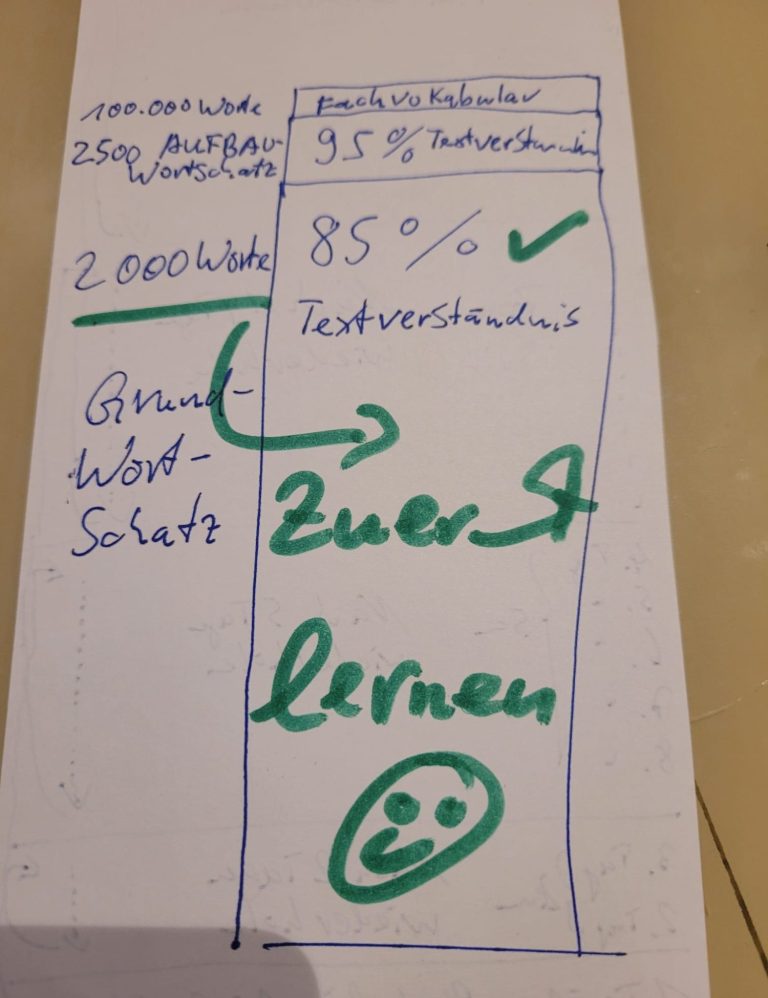
Einige Studien besagen, dass man mit 2000 Wörtern 85% und mit weiteren 3000 Wörtern 95% eines Textes verstehen kann. Grund- und Aufbauwortschatz.
What vocabulary should you learn?
Some studies suggest that knowing 2,000 words allows you to understand 85% of a text, and knowing an additional 3,000 words allows you to understand 95%. The Basic and advanced vocabulary.
In the past, Klett Publishing offered basic and advanced vocabulary lists for many languages; today, Cornelsen Publishing does. It’s worth learning the basic vocabulary first and then the advanced vocabulary.
Vocabulary lists are also available online: Search for “basic vocabulary” and “advanced vocabulary.”
Since I don’t learn grammar rules, I’ve also written short sentences (“I love you!”) on my flashcards, or complete conjugations of a verb (present tense: ich bin, Du bist, er/sie ist, etc.)
Please don’t forget to learn special features right away: for example, not just “Sonne” but “die Sonne” with the article (indicating male/female/neutral); the comparative and superlative forms (good, better, the best); and, for languages with tones, the tones (Chinese, Thai, Vietnamese...) or regular/irregular verb forms.
Since I wrote my own flashcards, the front always had the German word in my native language, and the back had the word in the language I was learning.
Example: Front—“gut”; Back: UK: “good, better, the best,” Chinese: hǎo (plus the character 好, which I wrote in a notebook before flipping the card over to check if it was correct)
When I was in China, my self-defined goal was to be able to buy jasmine tea (and other groceries) on my own. After 3 weeks, 4–6-hours per day writing and studying my flashcards I achieved my goal and went shopping. However I didn't learn the characters at that time, I only wanted to speak, so I used the phonetic spelling Pinjin to learn.
Later, though, I was intrigued by the Chinese characters and wanted to be able to read them, so I started learning the characters again from scratch....
For my first time, I compiled most of my vocabulary myself, since the various types of vegetables, teas and fish aren't part of a standard vocabulary.
Nether are the 10 different types of chili peppers I bought at markets in Mexico, which I then cooked separately in tomato sauce to learn their taste and their names.
A "visual" flashcard -
method
Learn flashcards efficiently
Start slowly!
For learning a language and/or flashcards your brain has to be trained.
If you study regularly, you can learn more and more each day.
Per day I start with 10-20 cards. After 3 months I am able to learn 50 new (+50 not remembered) flashcards per day.
To avoid learning words repeatedly which I already know, I use a special flashcard box system concentrating on the words I still have to learn.
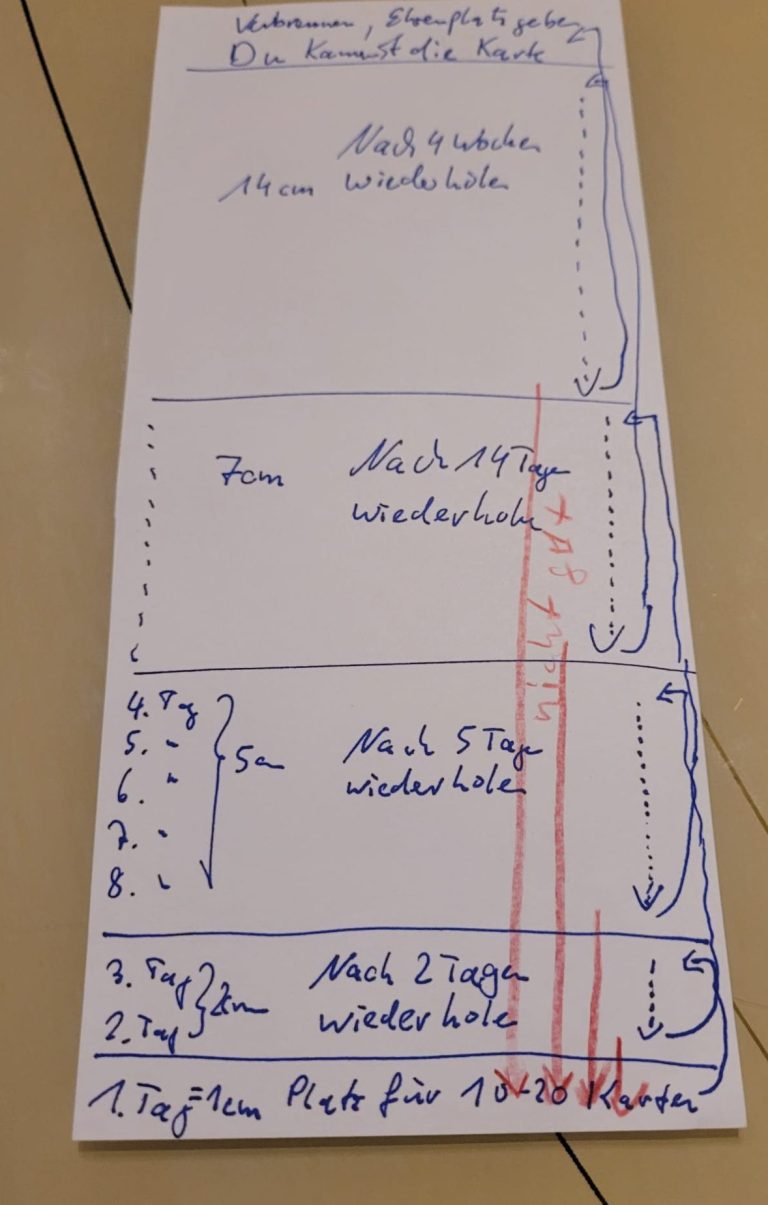
Easy vocabulary will be learned a first time, then repeated after 2 days, then 5 days, 2 weeks and 4 weeks. If I still know them after 4 weeks, probability is high that I remember them even after one year.
My own built wooden flashcard box hat one section 1 cm long, then 2 cm, 5 cm and 10 cm long (see picture)
The new flashcards (consisting of those cards I did not know the day before and newly written cards ) start in the 1 cm first section. If I know all these cards, I put them at the rear of the 2 cm section. And to be able to do so I need to take out about the same amount of flashcards at the front of the 2cm section.
These flashcards I repeat, the ones I know go to the end of the 5cm section, the ones I don't know will start from the beginning the next day. To get space in the 5 cm section, I take out flashcards from the front of this section to repeat them and put them in the 7 cm section (or back to the start), and so on for the last sections.
If I still know a flashcard after passing through the 10 cm section, then I will reward myself.
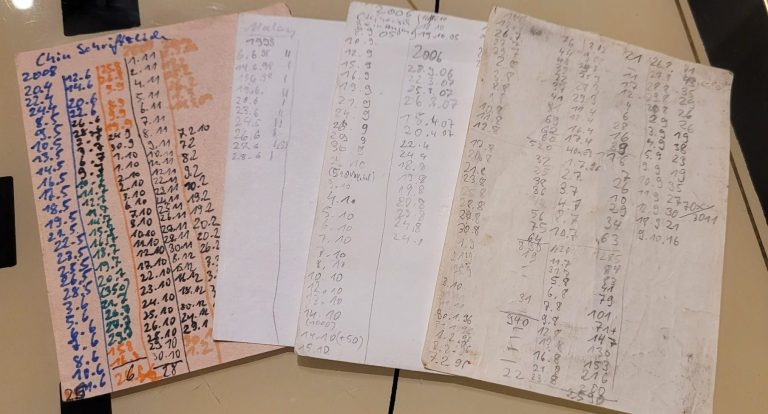
Burn the flashcard, write down my statistics with the date of study session and number of cards I have mastered. (see picture with statistics for different languages. The white dirty one was Portuguese in 1995, the rose one was Chinese characters.
For practical reasons I replaced my wooden box by a candy tin in 3 leves. and only used colored dividers.
Now my cards have the size of 22x71 mm (cut a DIN A4 sheet of paper in 3 strips, then cut the strips into 14 cards) to fit the candy tin.
In Brasilien wurde mir ein Job als Consultant für Business Reengineering angeboten.
Da ich kein Portugiesisch sprach, vereinbarte ich, dass ich während der Arbeitszeit die Sprache lernen könne.
Die erste Zeit lernte ich im Büro vormittags 3-4 Stunden Vokabeln mit meinem Karteikastensystem, nachmittags wurde ich von einem Kollegen bei der Arbeit begleitet - als Übersetzer. Abends lernte ich oft nochmals 1 1/2 Stunden oder das Doppelte.
Nach 3 Monaten war ich allein arbeitsfähig und reduzierte das Vokabellernen auf einen Durchgang (1 1/2 Stunden) während der Arbeitszeit, nach 6 Monaten war die Sprache für mich keine Hürde mehr.
Nach einem Jahr kam unser offizieller Übersetzer manchmal zu mir, da ich ein besseres technisches Fachvokabular hatte.
Meine Dokumentationen ließ ich aber immer von einer Kollegin sprachlich überarbeiten.
Sprechen ist nicht gleich Schreiben!
Für das Unternehmen hat sich diese Vorgehensweise sehr rentiert und ausgezahlt.
Learn from a native speaker
All over the world you will find language teachers who offer online lessons.
Book somebody who is native speaker to learn directly the correct pronunciation. Nothing worse than to take over the bad accent from your teacher who is not perfect himself in pronunciation.
For Japanese language it is even better to have a native speaker of the same sexual orientation/gender as yourself as their intonation differs between male and female speakers.
Die Mehrheit derjenigen, die Sprachen lehren oder lernen möchten haben eher ein auditives Gedächtnis, weshalb Sprachkurse und Sprachunterricht eher auf auditive Methoden abgestimmt sind.
Als optischer Lerntyp bin ich mit Sprachkursen /-unterricht in der Gruppe jedoch nie sonderlich glücklich geworden.
Auch ist der Lernfortschritt bei jeder Person unterschiedlich - es geht also zu schnell - oder oft auch zu langsam vorwärts.
Beim Einzelunterricht konnte ich meinen Lehrern vermitteln, wo meine Defizite sind und damit war der Unterricht viel effizienter - Spanisch, Chinesisch und Guarani habe ich jedoch ohne Sprachunterricht (aber viel vor Ort) selbst gelernt.
Zweisprachige
Erziehung
Wer die Möglichkeit hat, es macht später Sprachenlernen viel einfacher
Kleinkinder lernen ihre Muttersprache und ihre Vatersprache.
Wenn die Eltern zwei unterschiedliche Sprachen (oder Dialekte) sprechen, so lernen die Kleinkinder automatisch beide Sprachen.
Wichtig ist nur, dass eine Bezugsperson immer die gleiche Sprache mit dem Kind spricht, damit es nicht zu einem Kauderwelsch kommt.
Wenn eine weitere Bezugsperson wiederum eine andere Sprache spricht, geht das auch und das Kind ist Dreisprachig.
Achtung: wenn eine Bezugsperson künstlich eine Fremdsprache mit dem Kind spricht, übernimmt das Kind automatisch die Fehler und die (falsche) Aussprache.